Care & schedule
How often should you pump a septic tank?
The official range is 3 to 5 years for most houses. Household size, water use, and what you put down the drain can shorten that — especially on a well-and-septic lot in Golden Gate Estates.
How often should a household septic tank be pumped?
The U.S. EPA says a typical household tank should be inspected at least every three years and is usually pumped every three to five years, depending on tank size, household size, and how much wastewater and solids you generate1. Florida DEP gives the same 3-to-5-year window and says to use a state-licensed septage service2. In Collier County we like to get ahead of the rainy season, when a high water table makes a full tank less forgiving.
Pump-interval guide
This uses the U.S. EPA’s general 3-to-5-year window, adjusted by the factors the EPA lists: household size, wastewater generated, and solids. It is guidance, not a measurement of your tank. The real trigger is the sludge and scum the technician sees when the lid is open.
Source: U.S. EPA, How to Care for Your Septic System. Alternative systems with pumps or electrical parts generally need a look every year.
What actually decides the date?
A calendar is a starting point, not a measurement. The EPA says a tank should be pumped if the bottom of the scum layer is within six inches of the bottom of the outlet, if the top of the sludge layer is within 12 inches of the outlet, or if sludge and scum together make up more than 25 percent of the liquid depth1. That is why we look while the lid is open and tell you what we saw.
The major factors the EPA lists are household size, how much wastewater you generate, the volume of solids in that water, and the size of the tank1. A garbage disposal, a house full of guests, or a running toilet can pack a tank faster. Alternative systems with pumps or electrical parts generally need a look every year1.
Why spring is a smart window in Collier County
Our wet season loads the soil under the drain field. A tank that is already heavy with sludge has less room to hold what the house puts out, and a saturated yard is a poor time to learn the field is stressed. A pump-out before the rains is not a rule, and we will not invent a county deadline that does not exist. It is simply a practical habit on well-and-septic lots, including Golden Gate Estates.
What we do on a visit
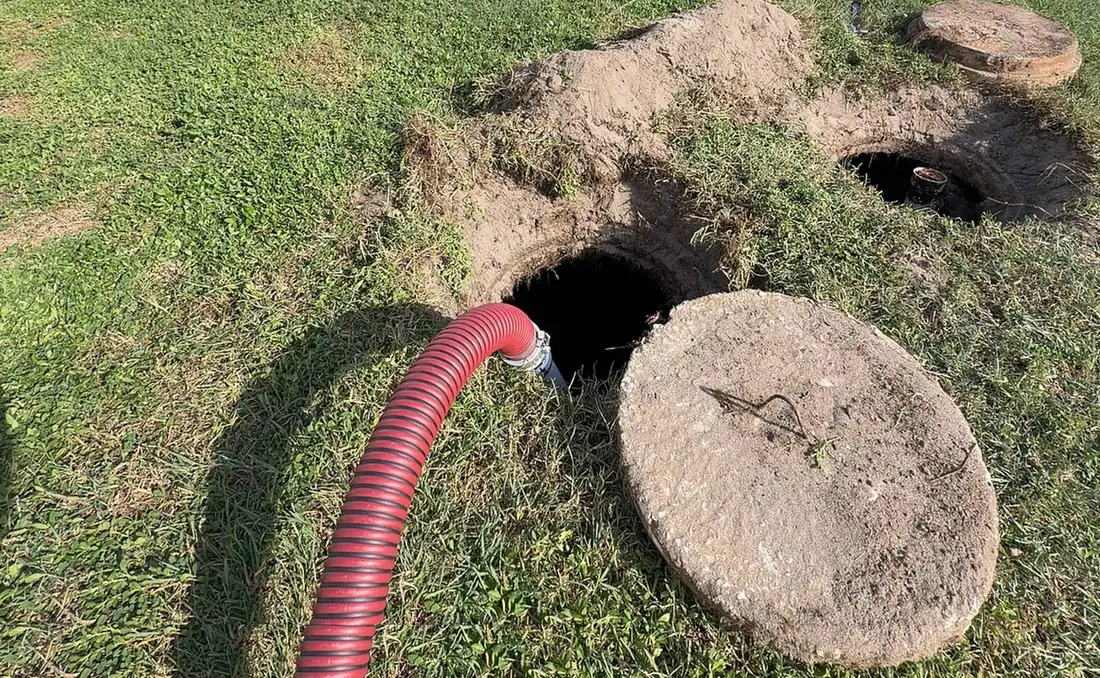
We pump both compartments, which is how Florida rule 62-6.010 describes a proper pump-out: the contents of all chambers are to be removed, unless a partial pump-out is explained in writing to the owner3. We look at the inlet, the outlet, and the filter if there is one, then tell you what we saw in plain language.
Related
Questions
Is a 3-to-5-year schedule a legal deadline in Florida?
It is official guidance from the U.S. EPA and Florida DEP, not a substitute for what a technician sees in your tank. Some systems, especially aerobic units, need more frequent attention.
Does a garbage disposal change the interval?
Yes. A disposal adds solids, which is one of the factors the EPA says shortens the time between pump-outs.
Do you measure sludge and scum?
We look while the tank is open and tell you what we saw. The EPA thresholds — scum within 6 inches of the outlet, sludge within 12 inches, or more than 25 percent of the liquid depth — are the standard we use to talk about whether a tank was due.
Ready when your tank is.
Open 24 hours for backups. For routine pumping, send a request and we'll confirm a time with you.