Getting started
How does a septic system work?
Wastewater from the house flows into a buried tank. Solids settle, scum floats, and the clearer liquid in the middle goes out to a drain field, where the soil finishes the job.
How does a household septic system work?
The tank is a settling box. Heavier solids fall as sludge, grease and lighter material rise as scum, and the clearer liquid in between — the effluent — flows out to the drain field. Bacteria in the tank break some of this down, but not all of it. Pumping removes the sludge and scum before they reach the laterals.
Inside the tank
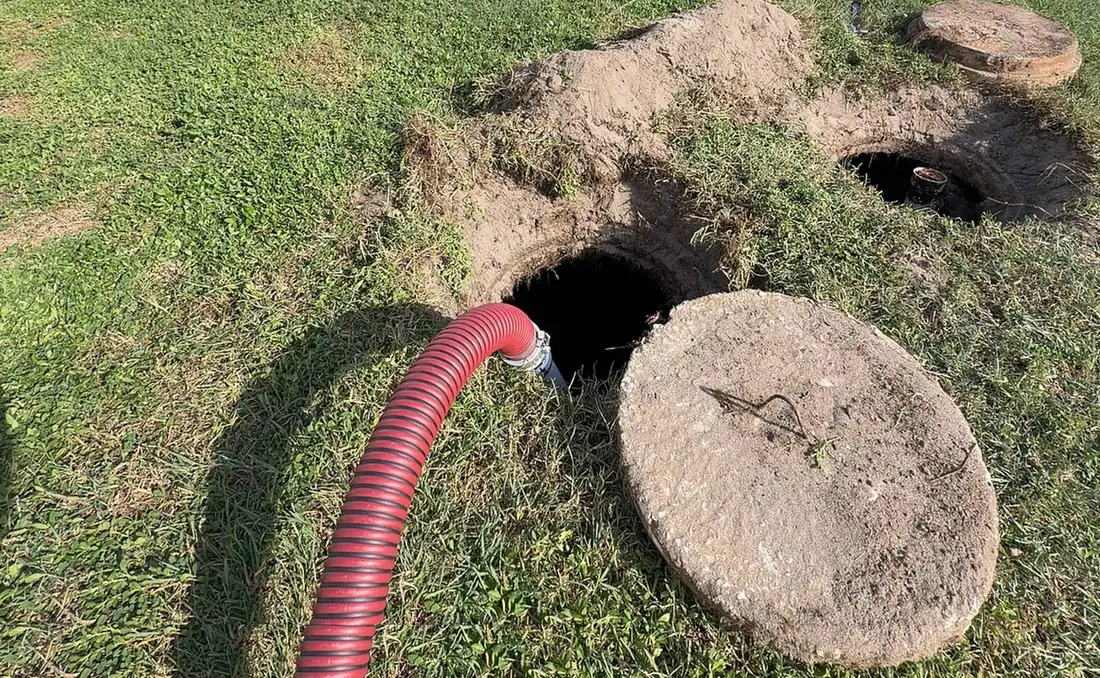
Most household tanks have two compartments, or two tanks in series. Waste enters the first chamber, where most of the settling happens. Liquid then moves through a baffle or tee into the second chamber, which gives the effluent another chance to clarify before it leaves through an outlet tee, often with a filter. That is why we pump both sides. Florida rule 62-6.010 says the contents of all chambers are to be removed when a tank is pumped, unless a partial pump-out is documented to the owner1.
In the drain field
Effluent flows into trenches or chambers in the yard. The soil treats it as it soaks down. If solids, grease, or too much water arrive at once, the soil can clog or saturate. That is the failure you want to avoid. See drain field care.
What pumping changes
Pumping does not “clean the field.” It resets the tank’s reserve so the field only receives effluent. We look at the tees and the filter while the tank is open because those parts tell us whether the system is still doing this job.
Related
Questions
Is the drain field the same as the tank?
No. The tank is the box we pump. The drain field is the soil system in the yard that receives the liquid.
Why two compartments?
Two chambers (or two tanks) give solids a second chance to settle before effluent leaves for the field. Pumping only the first chamber leaves the second one loaded.
Ready when your tank is.
Open 24 hours for backups. For routine pumping, send a request and we'll confirm a time with you.